

Press Release: "Faculty of Economics and Business at UPN “Veteran” Yogyakarta and Ming Chi University of Technology, Taiwan, Strengthen Collaboration for Impactful and Sustainable Community Empowerment"
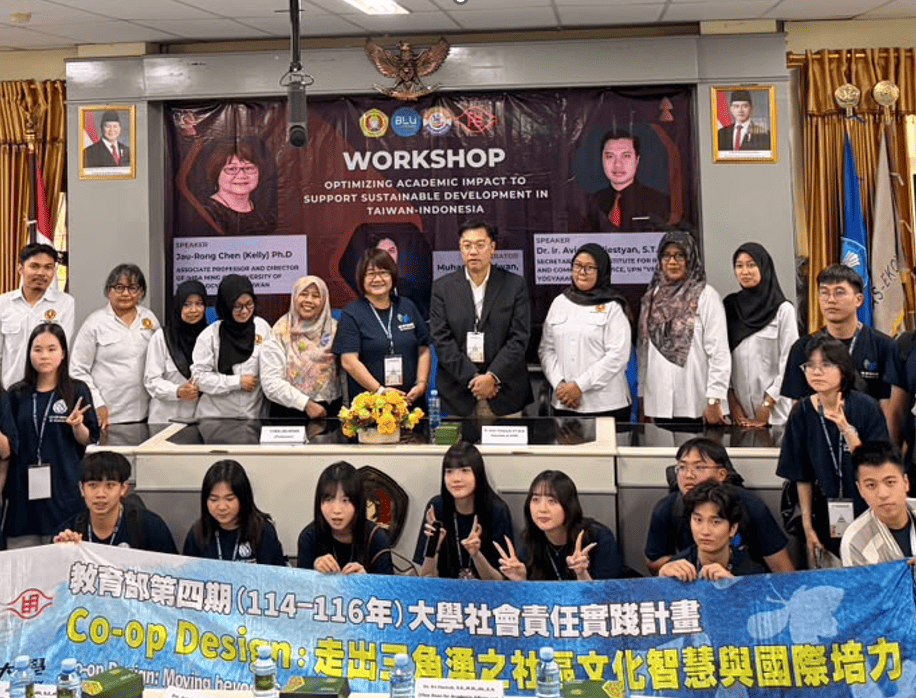
Yogyakarta, October 5, 2026 – The Faculty of Economics and Business (FEB) at Universitas Pembangunan Nasional “Veteran” Yogyakarta welcomed an academic delegation from Ming Chi University of Technology (MCUT), Taiwan. The delegation, comprising two faculty members and 17 students, participated in a workshop on Monday, October 5, 2026, to exchange best practices in community engagement between UPN “Veteran” Yogyakarta and MCUT. The workshop was attended by faculty members and students from six study programs within FEB and explored how higher education institutions can deliver meaningful and sustainable impacts through community empowerment initiatives.
During the workshop, Prof. Jau-Rong (Kelly) Chen, Head of University Social Responsibility at MCUT and Director of the International Master of Business Administration (IMBA) program, delivered a presentation entitled “From Research to Impact: Building Sustainable Academic Collaboration between Taiwan and Indonesia.” She introduced the Sanxia Living Lab, a sustainable collaborative platform connecting faculty members, students, and local partners. The initiative has reached more than 4,351 participants through 120 activities, including 986 international participants and 1,041 community members. This approach is implemented through the PLACE learning model, which stands for Place-based Learning, Local Cultural Immersion, Action-oriented Collaboration, Cross-cultural Communication, and Experiential Reflection. The model connects research, classroom learning, and community-based practice in a continuous improvement cycle informed by feedback from local partners.
Representing UPN “Veteran” Yogyakarta, Dr. Avido Yuliestyan presented a community engagement management model that integrates faculty community service grants with the university's student community service program, known as Kuliah Kerja Nyata (KKN). Faculty grants provide equipment and technical expertise, while multidisciplinary KKN teams contribute time, on-site engagement, and daily assistance. For example, in Wonokromo Village, Wonosobo, an organic waste shredding machine was integrated with composting activities and black soldier fly (BSF) maggot cultivation. The initiative was supported by standard operating procedures (SOPs), training, and the involvement of local operators to ensure that the system would remain operational after the students returned to campus.
Collaborative Community Engagement in Wukirsari Village
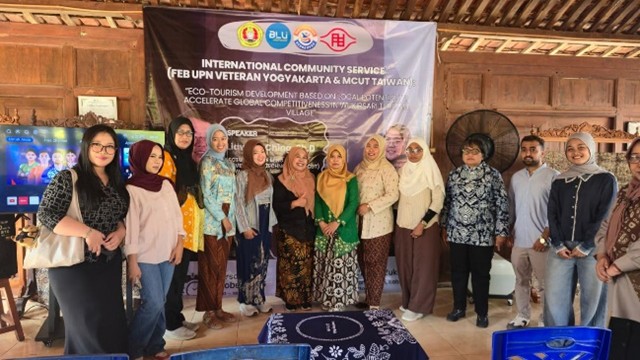
The program continued with a collaborative community engagement initiative in Wukirsari Village, Imogiri, Bantul, on October 8, 2026. The activity was organized by the international team of the Department of Management and involved the MCUT delegation and students from three study programs within FEB.
Wukirsari is one of the villages supported by the Faculty of Economics and Business. During the second semester of the 2025/2026 academic year, the undergraduate Management Study Program also implemented the Merdeka Belajar Kampus Merdeka (MBKM) Village Development Program in the village. Ten students participated in the program, spending one semester learning and engaging directly with the local community. Through this initiative, students could earn academic credits equivalent to 12–20 semester credit units (SKS).
According to the Head of the Department of Management, Dr. Titik Kusmantini, S.E., M.Si., the Village Development Program has generated several valuable outcomes for local partners. These include assistance with digital marketing, the development of an application-based database, and a draft intellectual property publication documenting the batik motifs in the collection of the Giriloyo Hand-Drawn Batik Association.
Safina, Head of the Village Development Program, explained that the database of batik motifs and their philosophical meanings was developed to educate both domestic and international tourists. By simply scanning the barcode attached to each piece of fabric in the association's showroom, visitors can access information about the artisan who created it, its price, production time, and the name and philosophy behind the batik motif.
Asri Sekar Firdaus, S.M., M.Sc., Head of the Undergraduate Management Study Program, added that partner villages provide students with opportunities to identify local potential and challenges while developing solutions in collaboration with community partners.
On the same occasion, Dr. Titik Kusmantini, S.E., M.Si., representing the community engagement team, presented the initiative entitled “Empowering Batik SMEs through Lean Six Sigma at the Giriloyo Hand-Drawn Batik Association, Wukirsari, Bantul.” As the principal investigator of the 2026 Internal Community Service Grant, she handed over personal protective equipment (PPE), including rubber boots, rubber gloves, and rubber aprons, for artisans to use during the pelorodan process, in which wax is removed from dyed batik fabric.
The equipment is intended to improve artisans' occupational safety while supporting a redesigned working environment that is more ergonomic, safer, and conducive to faster production workflows. Another component of the community engagement initiative involved educating artisans on process flow diagrams and the various stages of batik production. The training helps them identify bottlenecks and activities that do not add value, as well as collaboratively develop solutions and follow-up measures to mitigate production-related challenges.
The activities reinforced a central message shared by both speakers: meaningful community empowerment emerges from sustained collaboration, is rooted in local needs, and involves community partners from the outset.
During their visit to Yogyakarta from October 3 to 10, 2026, the MCUT delegation participated in a series of collaborative activities. Prof. Januar Eko Prasetio, S.E., M.Si., Akt., expressed his hope that the two institutions would pursue further collaboration in the future. Potential initiatives include comparative case studies on local development, joint student projects involving participants from both universities, and faculty exchanges to advance collaborative research and teaching.