

Press Release: "Development Economics Study Program, Faculty of Economics and Business — Curriculum Evaluation Workshop 2024 and Strengthening the Implementation of OBE-Based Semester Learning Plans"
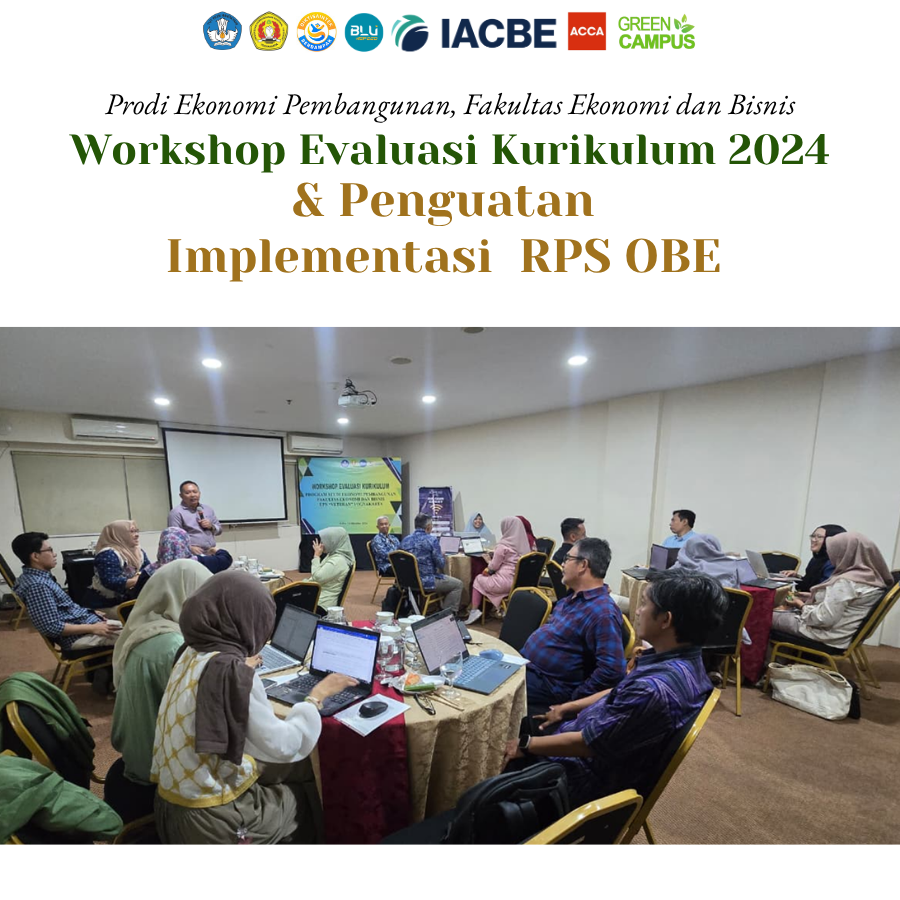
Yogyakarta, October 14, 2026 — The Development Economics Study Program, Faculty of Economics and Business (FEB), Universitas Pembangunan Nasional “Veteran” Yogyakarta, held a Curriculum Evaluation Workshop on Wednesday, October 14, 2026. The event formed part of the study program’s commitment to improving the quality of higher education through curriculum evaluation and refinement to ensure adaptability to developments in economics, labor market needs, and the competency requirements for graduates at both national and international levels.
The workshop was officially opened by the Dean of the Faculty of Economics and Business at UPN “Veteran” Yogyakarta, Prof. Dr. Januar Eko Prasetio, S.E., M.Si., A.K., CA., ASEAN CPA., MPA. The event was attended by all faculty members of the Development Economics Study Program, students, alumni, and various stakeholders. The participation of these groups reflected the importance of collaborative engagement in evaluating the quality of educational delivery and ensuring that the curriculum meets academic requirements and responds to developments in the professional world.
The workshop focused on evaluating the currently implemented 2024 Curriculum, including a review of its structure, course content, Graduate Learning Outcomes (Capaian Pembelajaran Lulusan/CPL), and teaching and learning strategies. The evaluation aimed to identify aspects that should be maintained, strengthened, or refined to ensure that the curriculum remains relevant to developments in development economics and the competency requirements for graduates.
One of the key agenda items was the development of English-language Semester Learning Plans (Rencana Pembelajaran Semester/RPS) based on Outcome-Based Education (OBE). This initiative represents a strategic step toward strengthening the implementation of the 2024 Curriculum through learning plans oriented toward measurable learning outcomes. The OBE approach emphasizes alignment among Graduate Learning Outcomes (CPL), Course Learning Outcomes (Capaian Pembelajaran Mata Kuliah/CPMK), learning materials, teaching methods, and assessment systems. Accordingly, the learning process focuses not only on delivering course content but also on ensuring that students achieve the expected competencies.
The development of English-language OBE-based Semester Learning Plans also forms part of the study program’s efforts to strengthen the internationalization of education. The use of English in instructional documents is expected to support international academic collaboration, student and faculty mobility, and the utilization of internationally recognized literature and learning resources. This initiative may also provide a foundation for developing international classes and various forms of educational cooperation with partner universities.
In the context of the 2024 Curriculum evaluation, preparing English-language OBE-based Semester Learning Plans involves more than simply translating documents into English. The process also provides an opportunity to review the quality of instructional planning, the precision of learning outcome formulations, the alignment of teaching methods and assessment instruments, and the relevance of course materials to graduate competency requirements. The evaluation findings are expected to inform improvements to instructional documents, making them more systematic, measurable, and focused on student learning outcomes.
The involvement of students, alumni, and stakeholders provided valuable perspectives for the evaluation process. Student feedback can serve as a basis for reflecting on learning experiences, while insights from alumni and stakeholders help assess the relevance of graduate competencies to labor market requirements and developments in the economic sector. Faculty members also play a crucial role in ensuring the academic soundness of course content, alignment with developments in the discipline, and the application of teaching methods that support competency attainment.
Through this Curriculum Evaluation Workshop, the Development Economics Study Program at the Faculty of Economics and Business, UPN “Veteran” Yogyakarta, reaffirmed its commitment to the continuous improvement of educational quality. The evaluation of the 2024 Curriculum and the development of English-language OBE-based Semester Learning Plans are expected to serve as concrete measures to strengthen the quality of the learning process, enhance graduate competitiveness, and support the development of a study program aligned with higher education quality standards and a global perspective.
Through collaboration among faculty members, students, alumni, and stakeholders, the Development Economics Study Program is expected to continue developing a curriculum that remains relevant to contemporary challenges while producing graduates who are competent, adaptable, and capable of making meaningful contributions to inclusive and sustainable economic development.