

Economics Development
Developmental Economics is one of the study programs available in the FEB UPN "Veteran" Yogyakarta, which is currently accredited as Excellent.
Bulletin Information
Tracer Study of Graduates

Press Release: "Development Economics Study Program, Faculty of Economics and Business — Curriculum Evaluation Workshop 2024 and Strengthening the Implementation of OBE-Based Semester Learning Plans"
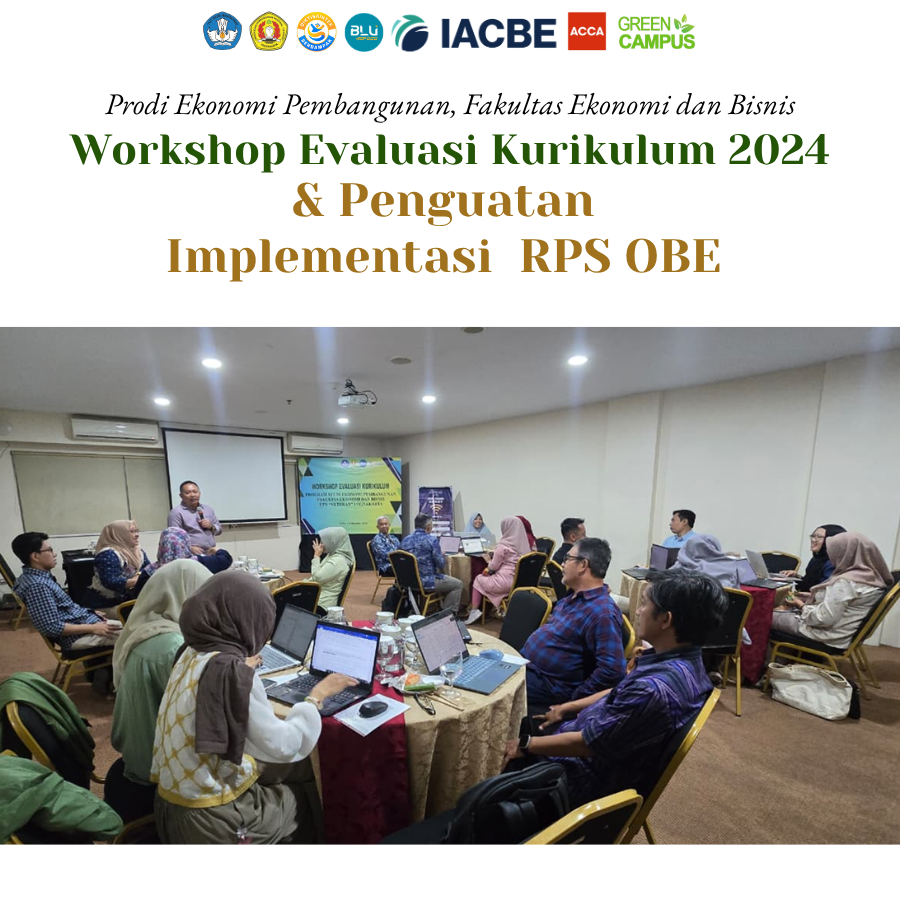
Yogyakarta, October 14, 2026 — The Development Economics Study Program, Faculty of Economics and Business (FEB), Universitas Pembangunan Nasional “Veteran” Yogyakarta, held a Curriculum Evaluation Workshop on Wednesday, October 14, 2026. The event formed part of the study program’s commitment to improving the quality of higher education through curriculum evaluation and refinement to ensure adaptability to developments in economics, labor market needs, and the competency requirements for graduates at both national and international levels.
The workshop was officially opened by the Dean of the Faculty of Economics and Business at UPN “Veteran” Yogyakarta, Prof. Dr. Januar Eko Prasetio, S.E., M.Si., A.K., CA., ASEAN CPA., MPA. The event was attended by all faculty members of the Development Economics Study Program, students, alumni, and various stakeholders. The participation of these groups reflected the importance of collaborative engagement in evaluating the quality of educational delivery and ensuring that the curriculum meets academic requirements and responds to developments in the professional world.
The workshop focused on evaluating the currently implemented 2024 Curriculum, including a review of its structure, course content, Graduate Learning Outcomes (Capaian Pembelajaran Lulusan/CPL), and teaching and learning strategies. The evaluation aimed to identify aspects that should be maintained, strengthened, or refined to ensure that the curriculum remains relevant to developments in development economics and the competency requirements for graduates.
One of the key agenda items was the development of English-language Semester Learning Plans (Rencana Pembelajaran Semester/RPS) based on Outcome-Based Education (OBE). This initiative represents a strategic step toward strengthening the implementation of the 2024 Curriculum through learning plans oriented toward measurable learning outcomes. The OBE approach emphasizes alignment among Graduate Learning Outcomes (CPL), Course Learning Outcomes (Capaian Pembelajaran Mata Kuliah/CPMK), learning materials, teaching methods, and assessment systems. Accordingly, the learning process focuses not only on delivering course content but also on ensuring that students achieve the expected competencies.
The development of English-language OBE-based Semester Learning Plans also forms part of the study program’s efforts to strengthen the internationalization of education. The use of English in instructional documents is expected to support international academic collaboration, student and faculty mobility, and the utilization of internationally recognized literature and learning resources. This initiative may also provide a foundation for developing international classes and various forms of educational cooperation with partner universities.
In the context of the 2024 Curriculum evaluation, preparing English-language OBE-based Semester Learning Plans involves more than simply translating documents into English. The process also provides an opportunity to review the quality of instructional planning, the precision of learning outcome formulations, the alignment of teaching methods and assessment instruments, and the relevance of course materials to graduate competency requirements. The evaluation findings are expected to inform improvements to instructional documents, making them more systematic, measurable, and focused on student learning outcomes.
The involvement of students, alumni, and stakeholders provided valuable perspectives for the evaluation process. Student feedback can serve as a basis for reflecting on learning experiences, while insights from alumni and stakeholders help assess the relevance of graduate competencies to labor market requirements and developments in the economic sector. Faculty members also play a crucial role in ensuring the academic soundness of course content, alignment with developments in the discipline, and the application of teaching methods that support competency attainment.
Through this Curriculum Evaluation Workshop, the Development Economics Study Program at the Faculty of Economics and Business, UPN “Veteran” Yogyakarta, reaffirmed its commitment to the continuous improvement of educational quality. The evaluation of the 2024 Curriculum and the development of English-language OBE-based Semester Learning Plans are expected to serve as concrete measures to strengthen the quality of the learning process, enhance graduate competitiveness, and support the development of a study program aligned with higher education quality standards and a global perspective.
Through collaboration among faculty members, students, alumni, and stakeholders, the Development Economics Study Program is expected to continue developing a curriculum that remains relevant to contemporary challenges while producing graduates who are competent, adaptable, and capable of making meaningful contributions to inclusive and sustainable economic development.
Press Release: "Faculty of Economics and Business at UPN “Veteran” Yogyakarta and Ming Chi University of Technology, Taiwan, Strengthen Collaboration for Impactful and Sustainable Community Empowerment"
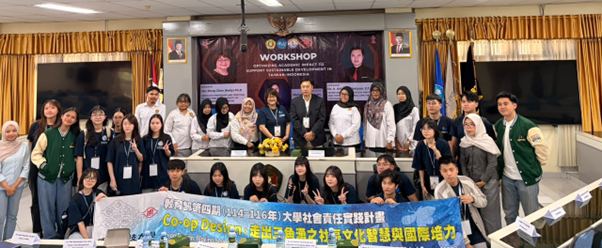
Yogyakarta, October 5, 2026 – The Faculty of Economics and Business (FEB) at Universitas Pembangunan Nasional “Veteran” Yogyakarta welcomed an academic delegation from Ming Chi University of Technology (MCUT), Taiwan. The delegation, comprising two faculty members and 17 students, participated in a workshop on Monday, October 5, 2026, to exchange best practices in community engagement between UPN “Veteran” Yogyakarta and MCUT. The workshop was attended by faculty members and students from six study programs within FEB and explored how higher education institutions can deliver meaningful and sustainable impacts through community empowerment initiatives.
During the workshop, Prof. Jau-Rong (Kelly) Chen, Head of University Social Responsibility at MCUT and Director of the International Master of Business Administration (IMBA) program, delivered a presentation entitled “From Research to Impact: Building Sustainable Academic Collaboration between Taiwan and Indonesia.” She introduced the Sanxia Living Lab, a sustainable collaborative platform connecting faculty members, students, and local partners. The initiative has reached more than 4,351 participants through 120 activities, including 986 international participants and 1,041 community members. This approach is implemented through the PLACE learning model, which stands for Place-based Learning, Local Cultural Immersion, Action-oriented Collaboration, Cross-cultural Communication, and Experiential Reflection. The model connects research, classroom learning, and community-based practice in a continuous improvement cycle informed by feedback from local partners.
Representing UPN “Veteran” Yogyakarta, Dr. Avido Yuliestyan presented a community engagement management model that integrates faculty community service grants with the university's student community service program, known as Kuliah Kerja Nyata (KKN). Faculty grants provide equipment and technical expertise, while multidisciplinary KKN teams contribute time, on-site engagement, and daily assistance. For example, in Wonokromo Village, Wonosobo, an organic waste shredding machine was integrated with composting activities and black soldier fly (BSF) maggot cultivation. The initiative was supported by standard operating procedures (SOPs), training, and the involvement of local operators to ensure that the system would remain operational after the students returned to campus.
Collaborative Community Engagement in Wukirsari Village
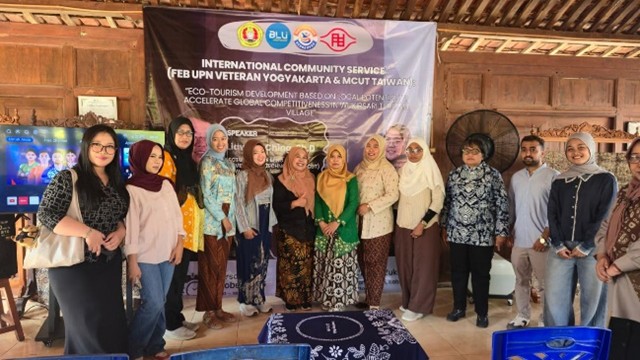
The program continued with a collaborative community engagement initiative in Wukirsari Village, Imogiri, Bantul, on October 8, 2026. The activity was organized by the international team of the Department of Management and involved the MCUT delegation and students from three study programs within FEB.
Wukirsari is one of the villages supported by the Faculty of Economics and Business. During the second semester of the 2025/2026 academic year, the undergraduate Management Study Program also implemented the Merdeka Belajar Kampus Merdeka (MBKM) Village Development Program in the village. Ten students participated in the program, spending one semester learning and engaging directly with the local community. Through this initiative, students could earn academic credits equivalent to 12–20 semester credit units (SKS).
According to the Head of the Department of Management, Dr. Titik Kusmantini, S.E., M.Si., the Village Development Program has generated several valuable outcomes for local partners. These include assistance with digital marketing, the development of an application-based database, and a draft intellectual property publication documenting the batik motifs in the collection of the Giriloyo Hand-Drawn Batik Association.
Safina, Head of the Village Development Program, explained that the database of batik motifs and their philosophical meanings was developed to educate both domestic and international tourists. By simply scanning the barcode attached to each piece of fabric in the association's showroom, visitors can access information about the artisan who created it, its price, production time, and the name and philosophy behind the batik motif.
Asri Sekar Firdaus, S.M., M.Sc., Head of the Undergraduate Management Study Program, added that partner villages provide students with opportunities to identify local potential and challenges while developing solutions in collaboration with community partners.
On the same occasion, Dr. Titik Kusmantini, S.E., M.Si., representing the community engagement team, presented the initiative entitled “Empowering Batik SMEs through Lean Six Sigma at the Giriloyo Hand-Drawn Batik Association, Wukirsari, Bantul.” As the principal investigator of the 2026 Internal Community Service Grant, she handed over personal protective equipment (PPE), including rubber boots, rubber gloves, and rubber aprons, for artisans to use during the pelorodan process, in which wax is removed from dyed batik fabric.
The equipment is intended to improve artisans' occupational safety while supporting a redesigned working environment that is more ergonomic, safer, and conducive to faster production workflows. Another component of the community engagement initiative involved educating artisans on process flow diagrams and the various stages of batik production. The training helps them identify bottlenecks and activities that do not add value, as well as collaboratively develop solutions and follow-up measures to mitigate production-related challenges.
The activities reinforced a central message shared by both speakers: meaningful community empowerment emerges from sustained collaboration, is rooted in local needs, and involves community partners from the outset.
During their visit to Yogyakarta from October 3 to 10, 2026, the MCUT delegation participated in a series of collaborative activities. Prof. Januar Eko Prasetio, S.E., M.Si., Akt., expressed his hope that the two institutions would pursue further collaboration in the future. Potential initiatives include comparative case studies on local development, joint student projects involving participants from both universities, and faculty exchanges to advance collaborative research and teaching.
Press Release: "2025 State Budget Fiscal Scenario Forum: “Resilient Fiscal Policy, Growing Economy""
Yogyakarta, September 19, 2025 – The Faculty of Economics and Business, UPN “Veteran” Yogyakarta, hosted the 2025 State Budget Fiscal Scenario Forum with the theme “Resilient Fiscal Policy, Growing Economy.” The event was organized through a collaboration between FEB UPN “Veteran” Yogyakarta and the Directorate of State Budget Strategy, Directorate General of Economic and Fiscal Strategy, Ministry of Finance of the Republic of Indonesia.
The event opened with welcoming remarks from the Dean of FEB UPNVY, who emphasized the importance of synergy between academics and practitioners in understanding the direction of Indonesia’s fiscal policy. He also encouraged students to take advantage of this opportunity as a real learning space to better prepare for future economic challenges.
Also present at the event were Mr. Wahyu Indrawan, Head of Subdirectorate for Program and Knowledge Management at the Directorate General of Economic and Fiscal Strategy, Ministry of Finance; Mr. Widiyanto, Senior Policy Analyst; and Dr. Ardito Bhinadi, S.E., M.Si., lecturer at FEB UPNVY, who also served as one of the speakers. The program, managed directly by the Directorate of State Budget Strategy in collaboration with the Macroeconomics and Banking Finance Laboratory of the Economics Department, FEB UPNVY, brought together 22 officials from the Ministry of Finance and 150 FEB UPNVY students.
Following the opening session, the agenda continued with a public lecture discussing the direction and challenges of fiscal policy for 2025–2026. The presentation provided insights into how fiscal policy is designed to safeguard economic resilience while promoting inclusive growth.
In the next session, participants received a more in-depth explanation of the Macroeconomic Assumptions (ADEM), fiscal policy, and the use of state budget simulation tools. This served as valuable preparation for students before entering the state budget drafting simulation.
The simulation was conducted in several classes, where students were divided into small groups to design a state budget framework based on given scenarios. With enthusiasm, they discussed spending priorities, revenue targets, and strategies to manage the deficit in line with fiscal rules. The activity not only tested students’ understanding but also trained them to think critically, collaboratively, and solution-oriented.
Toward the afternoon, each group presented the results of their simulation before the speakers and other participants. These presentations sparked lively discussions, enriched by responses and feedback from Ministry of Finance officials as well as UPNVY lecturers.
Overall, the event successfully achieved its objectives, namely:
-
To communicate fiscal policy and the impact of changes in Macroeconomic Assumptions (ADEM) on state budget planning.
-
To create a constructive discussion forum for the academic community to express aspirations and ideas related to national fiscal policy.
The forum concluded with the hope that students would continue to sharpen their understanding of public policy, while the collaboration between the Ministry of Finance and UPNVY would be further strengthened to produce a young generation ready to contribute to Indonesia’s economic development.
Press Release: "Jogja International Batik Biennale (JIBB) 2025 Goes to Campus: Gusti Putri Emphasizes the Importance of Understanding the Historical Value of Batik"
Yogyakarta, which has been designated as the World Batik City since October 2014 under the slogan “Jogja Kota Batik Dunia” (Jogja, World Batik City), continues to strengthen its commitment to preserving batik. Beyond its aesthetic value, batik also holds significant historical, global, environmental, and economic importance.
This message was conveyed by the Daily Chairperson of the National Crafts Council (Dekranas) of the Special Region of Yogyakarta, GKBRAA Paku Alam, when serving as a speaker at the Jogja International Batik Biennale (JIBB) 2025 Goes to Campus event on Friday (September 26). The event took place at the Seminar Room of the Faculty of Economics and Business, Accounting Building, UPN “Veteran” Yogyakarta.
In her presentation, Gusti Putri emphasized the importance for the people of Yogyakarta to understand the historical value and originality of Jogja Batik. She expressed regret if batik is viewed merely as clothing without recognizing its philosophical meaning.
“It is unfortunate if one only wears batik without knowing its historical value and originality. As people of Jogja, we must truly understand batik, because ultimately, we must cherish it,” she stated.
Gusti Putri also shared her experience as a batik artisan since 2011. Much of her inspiration comes from centuries-old manuscripts preserved at Pura Pakualaman. On this occasion, she also introduced the distinctive Asthabrata batik of Pura Pakualaman and explained the philosophy it embodies.
According to her, classical batik patterns such as kawung and parang have existed since ancient times and carry profound philosophical messages.
“Even if we do not make batik ourselves, we must still recognize that the philosophies within it are truly extraordinary,” she firmly concluded.